- Jul 16
Career coach, therapist, or coach? What actually helps mothers during matrescence
- Babette Lockefeer
- English
At some point, most mothers end up typing some version of the same search: career coach for moms, therapist for new moms, coaching versus therapy, do I need help or am I just tired. The honest answer is that the search itself is the hard part, because the labels available (coach, career coach, therapist, psychologist) were not built with matrescence in mind, and picking the wrong one wastes months.
Here is the distinction that actually matters. Matrescence, the developmental process of becoming a mother, is not a disorder. It should not be minimised, treated as something you should simply be managing better, and it should not be medicalised, treated as a psychological problem requiring clinical treatment. It is a normal, significant developmental transition, the adult equivalent of adolescence, and most of what you are feeling inside it needs a different kind of support than either of those two responses offers.
That does not mean every kind of support works equally well. It means the four options in front of you (a psychologist, a general coach, a career coach, or a coaching program built specifically around matrescence) are answering genuinely different questions, and most mothers only find that out after they have already paid for the wrong one.
When you actually need a psychologist
If what you are experiencing meets the bar of a clinical condition, a perinatal mood or anxiety disorder (PMAD): postpartum depression, postpartum anxiety, postpartum OCD, or postpartum psychosis, you need a licensed psychologist or psychiatrist, not a coach, not a career coach, and not a coaching program, this one included.
The signals worth taking seriously: low mood or anxiety that persists beyond two weeks, an inability to function in daily life, intrusive or frightening thoughts, disconnection from your baby, or any thought of harming yourself or your child. If any of that is present, please contact a healthcare provider now. Postpartum psychosis in particular is a psychiatric emergency and needs immediate care.
Here is the part that matters for everyone else: matrescence itself, the identity reorganisation, the confidence dip, the grief for your old life, the shift in what you want from your career, is not on that list. It is the normal, structural, developmental territory this whole site maps. A good psychologist treats what is clinical. Matrescence is not clinical, and the distinction genuinely matters, because there is also a real, practical problem on the psychologist side of this: most psychologists are trained in mental health, not in matrescence specifically, and an already overburdened mental health system does not need the normal developmental weight of becoming a mother added to its caseload. A psychologist without matrescence training will often treat the anxiety, the low mood, or the guilt as the whole problem and work on it in isolation, without the developmental frame that explains why it is there in the first place, and without ever naming the motherhood script or the ideal worker norm that may be generating it.
What general coaching gets right, and where it stops
A general 1:1 coach, life coach or leadership coach, is often a genuinely useful format: goal-setting, accountability, a structured space to think out loud. Coaching of this kind is not clinical treatment, and it should not be. It works well for a defined goal with a relatively stable starting point.
Matrescence is not a stable starting point. It is the ground shifting. A general coach without matrescence expertise will coach you toward the goal you arrived with, without necessarily questioning whether that goal is still yours, or whether it was ever fully yours to begin with, versus inherited from the motherhood script or from a career built entirely around the ideal worker norm. Coaching that does not account for the developmental reorganisation underneath the goal tends to produce competent plans for the wrong destination.
Why career coaching specifically runs into trouble here
Career coaching is the term most mothers actually search for, and it deserves its own honest answer, because career coaching is not wrong, it is simply built for a different moment than the one you are in.
If you are already established on the other side of matrescence, your identity has resettled, your values have stabilised, a good career coach can be exactly right: strategic, focused, effective. The problem is timing. During matrescence itself, your values and your definition of success are actively in flux, not a fixed input a career coach can strategise from. And your actual capacity to pursue any career move is heavily dependent on something most career coaching never touches: how things are organised at home, and whether the motherhood script and the ideal worker norm are quietly deciding, in the background, what you are even allowed to want.
This is why career coaching in isolation so often leaves the real question untouched. You go in asking how to get unstuck professionally. You come out with a plan, and you still do not know why you feel unambitious, or guilty, or like you have lost your edge, because career coaching was never built to ask that question. The honest answer, more often than not, is not that you have stopped wanting to work. It is that the transition itself, the accountability gap at home, the script's demand that a good mother's ambition comes second, has not been named yet. A career coach who has not been trained to see that will coach the symptom and miss the cause every time.
Where a matrescence-informed program is actually different
This is where a coaching program built specifically around matrescence, rather than general coaching or career coaching alone, earns its place. Mother on MY Terms, built on the Working Mom Renaissance Method™, is deliberately not therapy and not generic career coaching. It runs as group coaching: a cohort of mothers navigating the same developmental passage at the same time, working through the Map of Matrescence and the Matrescence Arc together, with the structural analysis (the motherhood script, the accountability gap, the ideal worker norm) named explicitly rather than assumed away.
The reason the group format matters is not incidental. Career coaching alone treats your ambition question as an individual puzzle. Matrescence-informed group coaching treats it as what it actually is: a developmental transition that happens to nearly every mother, and that a room full of mothers going through the same phase can recognise in each other faster than any 1:1 relationship can surface it alone.
A simple way to decide
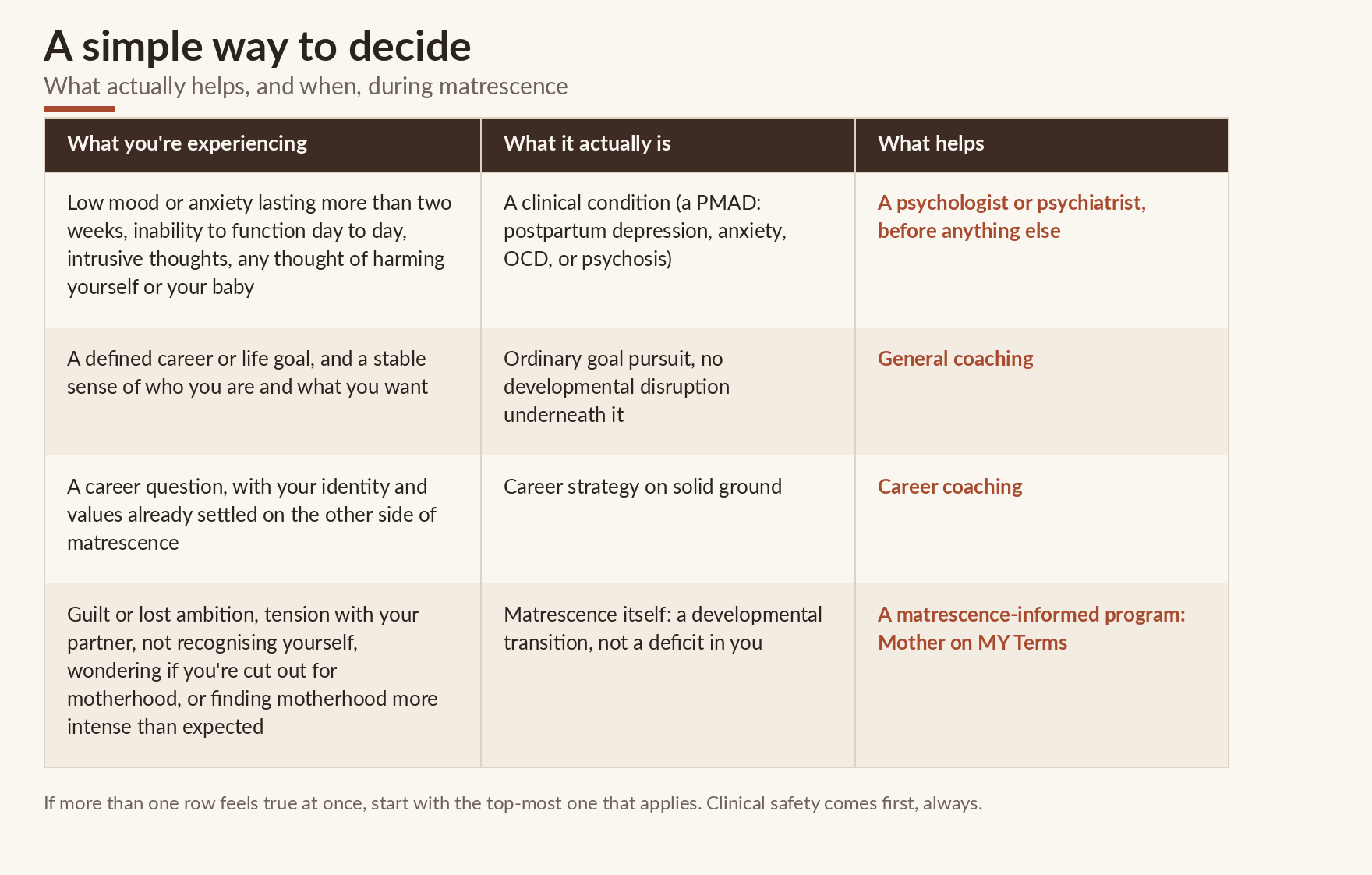
If more than one row feels true at once, start with the top-most one that applies. Clinical safety comes first, always.
About Babette Lockefeer
Babette Lockefeer is the founder of Matermorphosis and an expert at the intersection of leadership and matrescence. She built Mother on MY Terms specifically because she could not find coaching, career coaching, or therapy that treated the transition to motherhood and the career question as one connected system rather than two separate problems.
Her training sits deliberately across both worlds this page compares, rather than fully inside either one. From leadership development: a former leadership consultant at McKinsey and Alibaba, a certified Leadership Circle practitioner, and a trained facilitator (AoF). From coaching built specifically for the inner patterns that get in the way of change: a certified Positive Intelligence coach, the same framework behind the saboteur archetypes referenced throughout this site. From the matrescence field itself: mentored directly by matrescence sociologist Dr. Sophie Brock, PhD.
Frequently asked questions about coaching, career coaching, and matrescence
Do I need a therapist or a career coach during matrescence? It depends on what you are experiencing. If your symptoms are clinical, persistent low mood or anxiety, intrusive thoughts, inability to function, a psychologist or psychiatrist is the right first step, not a coach of any kind. If what you are navigating is the developmental transition of becoming a mother itself (identity, ambition, confidence, the division of labour at home), that is not a clinical condition, and a matrescence-informed coaching program will generally serve you better than general career coaching alone.
What is the difference between a coach and a psychologist for new mothers? A psychologist treats diagnosable clinical conditions, including perinatal mood and anxiety disorders (PMADs) such as postpartum depression and postpartum anxiety, and is a licensed medical professional. A coach works with people who do not have a clinical condition but want structured support toward a goal or through a transition. Matrescence itself sits in the coach's territory, not the psychologist's, unless a genuine clinical condition is also present, in which case both may be appropriate at once.
Can a career coach help with the identity crisis of becoming a mother? A general career coach can help with career strategy, but most career coaching is not built to address the developmental reorganisation happening underneath the career question during matrescence: the shift in your values, your definition of success, and the structural forces (the motherhood script, the ideal worker norm, the accountability gap at home) shaping what feels possible. Without that layer, career coaching often produces a solid plan aimed at the wrong underlying problem.
What is group coaching, and is it better than 1:1 coaching for this? Group coaching brings together several people navigating a similar transition at the same time, rather than working one-on-one. For matrescence specifically, group coaching has a particular advantage: the developmental transition is nearly universal among mothers, and a cohort of mothers in the same phase tends to recognise patterns in each other (the guilt, the ambition confusion, the invisible load) faster than a single coach working with one person in isolation.
How do I know if what I'm feeling is a mental health condition or just matrescence? The distinction is about persistence and function. Matrescence involves real disorientation, grief, confidence dips, and identity questions, but it does not typically involve symptoms lasting more than two weeks with no easing, an inability to function day to day, intrusive or frightening thoughts, or thoughts of harming yourself or your baby. If any of those are present, speak with a healthcare provider now. If what you are feeling is the developmental weight of the transition itself, that is matrescence, not a disorder, and it responds to a different kind of support.
Is Mother on MY Terms therapy, coaching, or something else? Mother on MY Terms is a coaching program, specifically group coaching built around the Working Mom Renaissance Method™, not therapy and not generic career coaching. It is designed for mothers navigating the normal developmental transition of matrescence who want their career, identity, and home life addressed together rather than in isolation. It is not a substitute for clinical treatment if a genuine mental health condition is present.
Free mini course
MaterMinutes - a quick intro into Matrescence
Sign up now and receive 7 days of curated audio snippets from influential and inspirational books about Matrescence in your inbox.